
Pronoia
an important vocab word for the state of the world today.

Also, typology.
I have long been a follower (fan? maybe) of tiny local newspaper the Boulder Weekly. Coming out each Thursday and populating the many free news kiosks across Boulder (but especially downtown), it boasted the Best of Boulder series, the crunchy-granola local politics, and the robust Boulder entertainment scene. These ingredients all came together into a lovely thing to leaf through over a Thirsty Thursday pint, back when I lived in Boulder, that is. But the highlight of these weekly leafings and grazings to me was the syndicated horoscope composed by the crazily poetic Rob Brezny.
Quick sidebar: as an adolescent, especially in junior high, I got very into astrology and Tarot. I had also just begun my journey into the arts of storytelling, and delved deep daily into fairy epics, Old Story, folklore, and symbology. And typology: I think that my love of horoscopes had to do with my brilliant yet developing brain finding it a soothing foray into pattern recognition, and recognizing people’s characteristics and type. Mid-8th grade, I changed my fashion style fully, dressing the way I wanted to, no longer trying to keep up with the popular girls (who terrorized me on a daily basis). Junior high was also when I first got into theatre, and became very good very quickly. And so, my new clothing style dissolved the bullying, and my acting training taught me about human behavior (and how to imitate various types of same). Horoscopes gave me a system of types that were well organized and recognizable. And learnable. And the Tarot showed me how symbol recognition could be an immensely satisfying way to organize my highly strung (albeit advanced) brain. Both practices gave me a way to sort my world into manageable types, while remaining charged with magic.
But back to Brezny: the reason I stayed with his horoscopes this far past my own personal interest, is his style. He composes full rich paragraphs for each sun sign each week, not just giving guidance but creating little prose poem gems that are inspiring and a good kickstart to your weekend, whether you believe in that stuff or not. Why is he relevant? Because he wrote a book called Pronoia.1
Pronoia
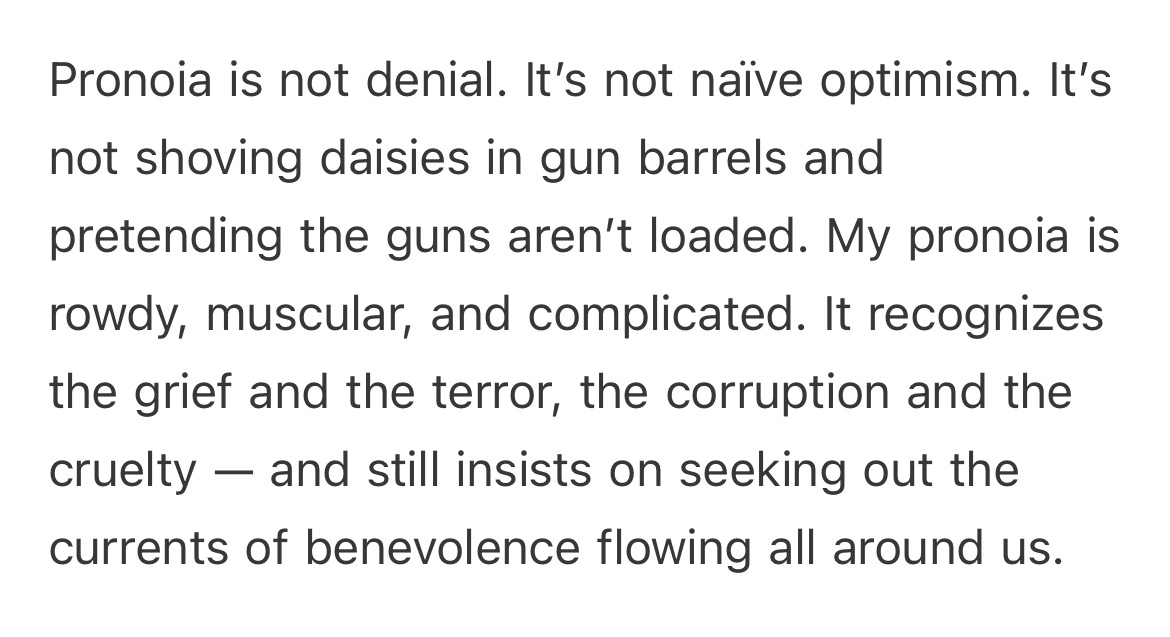
The definition of pronoia as coined newly (or at least popularized) by Brezny, basically is: the opposite of ‘paranoia.’ Where paranoia makes you think the world is out to get you, to sabotage everything you do, pronoia makes you think the world is full of possibilities.
Etymology (or in this case: Coinage)
As far as I can tell from my brief researches, This word began as a descriptor from late Byzantine era commerce: ‘a grant that temporarily transferred imperial fiscal rights to an individual or institution.’ From there, it became used in psychology to mean a delusion that’s equal yet opposite to paranoia.
The Wikipedia entry for the psychology version of pronoia shows this word to be more of a parallel problem in psychology to paranoia then what Brezny describes in my screenshot quote above: in the first iterations of the new definition, pronoia was considered just as delusional as paranoia, just in the opposite direction. But I like Brezny’s more powerful and empowered version, myself: not delusional in either a positive or negative direction, but realistic while still remaining hopeful. I feel like Brezny’s version of Pronoia epitomizes something I’ve seen online called hope-punk.
But I haven’t read Brezny’s book as yet, so. /shrug/ I may be missing something.
Typology
I bring up this secondary vocab word because when I was exploring all the history and etymology of pronoia, it occurred to me that this word has been coined from any original Greek temporary-granting-of-imperial-boons meaning it used to have, into the psychological counterpart (or opposite) of paranoia. It’s less a direct lineage as a re-coining. Plus I feel like horoscopes have everything to do with typology.
Toxic Positivity
Miss me with your manifestation and your forced positive thinking, please and thank you. That shit’s not helpful. It’s self-hypnosis when done to oneself and mean to the point of bullying when done to others. Worse, it’s ignorant and dangerous. Victim blaming. Everything happens for a reason, and the reason is, you’re not manifesting hard enough, right? Nonsense.
I’m not saying it’s better to drown in pessimism, though, either. That’s a path to dejected depression and inactive rotten madness at best, violent nihilism at worst. But to me the concept of pronoia isn’t that, either. Pronoia can be the best of both worlds: being fully aware of reality and yet not going all Denethor.2
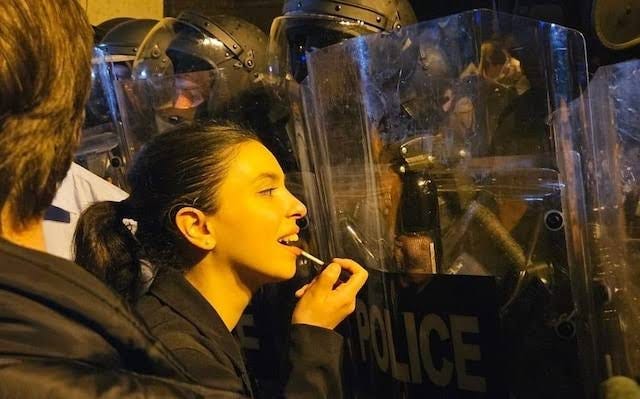
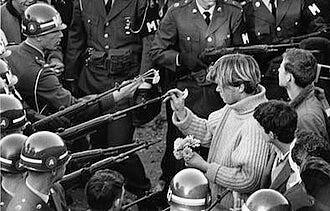
The lipstick pic above strikes me as a contemporary version of the famously iconic (and Pulitzer Prize winning) Flower Power image we all know and what Brezny refers to in the excerpt I included here. It’s a similar study in contrasts: the young golden haired man plugging carnations into gun barrels, and this young beautiful woman using a riot shield as a mirror for her makeup. And both images were captured in the throes of a massive protest. The metaphor of pronoia in both photos is profound.
To conclude, here’s some further readings re: the non-toxic (tonic?) positivity that is pronoia. I referenced these and referred to them often in the composing of my memoir, Next Time. It’s been a concept that has interested me for a while now, starting with my husband’s pet project, a business/memoir called The Power of Pessimism,3 and continuing on through my own memoir process. It’s useful and a powerful psychology, especially as society around us continues to implode, explode, and crumble.
Bright Sided by Barbara Ehrenreich (here)
A Cruel Optimism by Lauren Berlant (here)
Necessary Endings by Dr. Henry Cloud (here)
Looking up this book, I find that Brezny’s horoscope column first began in …1996?? How?! I feel like I’ve been reading his work for far longer than that. I was already graduated from college by 1996. What da…
Denethor is a character from Tolkien’s Lord of the Rings: the steward of Gondor, he uses the dangerous palantir too often, descending from shrewd and subtle ruler to self-immolation in ‘pride and despair’ when he thinks there’s no future from a conflict with Sauron; no chance of victory and therefore no reason for hope. I wrote about Denethor in detail in my lecturette on Corruption and Redemption in Lord of the Rings, so check that out for more on his particular flavor of despair.
He has not published this (fantastic) book yet, neither in book form nor on his Substack. Wanna join me in encouraging him to revise and share? It’s dead good.
I remember my oldest, when he was maybe ten, shaking his head at a bug or something and saying, “I don’t like that bug, Dad. It parannoys me.” Which made sense. You can get annoyed, and you can be paranoid. So the verb “to parannoy” seemed hard to argue with. Still does, though I’m sure there is a rich etymological rebuttal to be found.