
Antimetabole
a vocab word that makes me think of the most important key to performing Shakespeare that I learned in my BFA.

As always happens with these vocab word pieces, I immediately thought of another word when I first began digging into this one. It’s a word that I learned in most detail while in Shakespearean acting training for my BFA. Antithesis is essential for tackling Shakespearean text—when you know about how to find and emphasize and play with this art of contrasts and display of opposites, the complex verse becomes silky smooth, and flashingly ironic.
One of my favorite examples of extended antithesis is the dialogue between Gloucester and Anne in Richard III. It’s a wonderful tennis match of antithesis, too long for me to quote in full, but here’s some of it:
Richard III (Duke of Gloucester). Lady, you know no rules of charity,
Which renders good for bad, blessings for curses.
Lady Anne. Villain, thou knowst no law of God nor man:
No beast so fierce but knows some touch of pity.
Richard III (Duke of Gloucester). But I know none, and therefore am no beast.
Lady Anne. O wonderful, when devils tell the truth!
Richard III (Duke of Gloucester). More wonderful, when angels are so angry.
Vouchsafe, divine perfection of a woman,
Of these supposed evils, to give me leave,
By circumstance, but to acquit myself.
Lady Anne. Vouchsafe, defused infection of a man,
For these known evils, but to give me leave,
By circumstance, to curse thy cursed self.
Richard III (Duke of Gloucester). Fairer than tongue can name thee, let me have
Some patient leisure to excuse myself.
Lady Anne. Fouler than heart can think thee, thou canst make
No excuse current, but to hang thyself.
Richard III (Duke of Gloucester). By such despair, I should accuse myself.
Lady Anne. And, by despairing, shouldst thou stand excused;
For doing worthy vengeance on thyself,
Which didst unworthy slaughter upon others.
(from Act I, sc. 2)1
This is what I mean by an antithesis tennis match: look at how she comes back at him with a beautiful contrast to everything he says. Especially that part where he says ‘Vouchsafe, divine perfection of a woman…’ and she comes right back with, ‘Vouchsafe, defused infection of a man…’ and both those entire stanzas are wonderfully opposite.
But that’s okay that I got distracted by antithesis—in fact, it’s not really a distraction at all. Many of the best Shakespearean antitheses are also…
Antimetabole
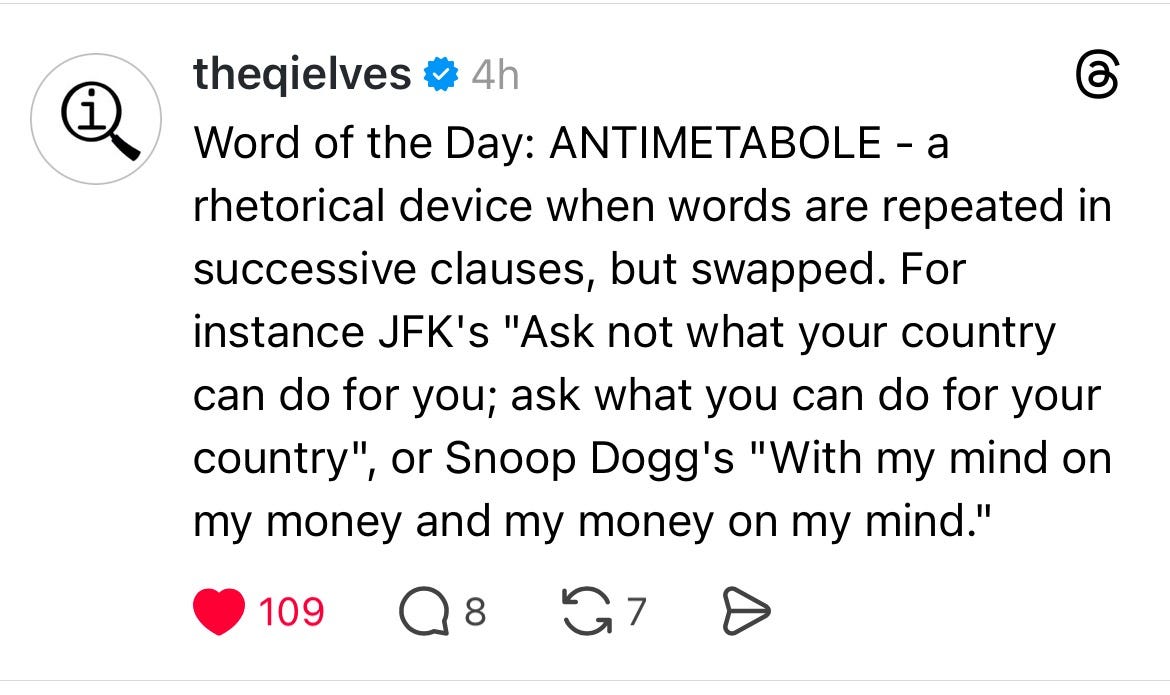
The definition of antimetabole is simple: right there on the qi tin. It’s a rhetorical device that uses switched repetition of words to form a sort of ironic twisty meaning. It comes from classical Greek: anti- meaning against, and -metabole meaning turning about. So that makes sense: a reversal of a turn.
Let’s play with some, shall we?
Of course I had to chuckle delightedly at the two examples in the qi meme. I mean, hey, the intellectual combination of JFK and Snoop Dogg? I’m here for it. And the Wikipedia page for the word has a really fun list of antimetaboles from several different categories of writing: criticism, literature, proverbs and sayings, lyrics, etc. Everything from Dr. Seuss to Dickens to Wilde. It’s hilarious, go look through them. And of course, the article brought up Yakov Smirnov, who of course has a shtick that’s entirely based on antimetabole. Their example: ‘In America, you can always find a party. In Soviet Russia, Party always finds you!’ You remember him, don’t you?
But my favorite antimetaboles are from antitheses in Shakespeare. I still own a few of my most useful textbooks from my acting training back in the BFA days, and I wanted to look again at one particular book’s section on antithesis in Shakespeare for this ‘mess’ay and so I yoinked it off my shelf. Now, obviously, all antithesis is not antimetabole. Like this line from one of Romeo’s speeches from Act I sc. 1 of Romeo & Juliet:
‘Feather of lead, bright smoke, cold fire, sick health, / Still-waking sleep…’
That’s lovely and a play on that opposition that is antithesis I talked about above. But as you can see, the repeated and reversed words that mark an antimetabole aren’t a part of this line.
And so how overjoyed was I when I discovered, tucked into the front cover of Freeing Shakespeare’s Voice, an ancient yellowed handout from my BFA acting class.2 It’s an easy-reference list of figures of speech, or patterns of language found most commonly in Shakespeare’s work, that helps to master the meaning. And on that list? ‘A repetition with reversal of word order.’ Huzzah! Antimetabole!
Some of my favorite Shakespearean antitheses that are also antimetaboles are in Hamlet. From two of my favorite monologues of Hamlet’s. The first? ‘Suit the action to the word, the word to the action.’ I’ve talked about Hamlet’s speech to the Players before, in my two-essay screed against Toxic Realism in theatre, mostly in Part One, so relook at that one if you’re interested in that particular monologue and my views of it. But the other antimetabole of Hamlet’s that I love is from his ‘O what a rogue and peasant slave am I’ soliloquy; again as he praises the skills of actors and the magic of their emotional art:
‘What’s Hecuba to him, or he to Hecuba, that he should weep for her?’ ~Hamlet
This is the soliloquy where Hamlet gets the idea to use the Players to smoke out his potentially murderous uncle. What gives him this idea is by marveling how the Leading Player had actual tears in his eyes as he performed a lamenting speech—he showed real emotion, says Hamlet, and for what? ‘For Hecuba?’3 He then goes on to wonder how amazing the emotions of the player would be expressed if he had a real life thing to lament about, like he himself does. David Tennant does a top shelf job at this role and this soliloquy in particular; check it out:
Side Note: Chiasmus
Antimetabole is often thought of as connected to, or maybe a type of, chiasmus. There’s a very slight difference between the two words (the one is often thought of as a subset or type of the other). According to Wikipedia, ‘Chiasmus balances words or phrases with similar, though not identical, meanings.’ In other words: in a chiasmus, the switched repeated words have slightly differing meanings. With antimetabole, the switched words have the same meaning; it’s just the switcheroo that makes us think differently about the meanings (and the relationship between same).
Anyway. How happy was I to do a little research in my own little library (not just online) for this ‘mess’ay! Paper books have been giving me much pleasure in recent weeks, even more so since we moved into the new house. It’s all part of a lovely torrent of analog art that I’ve been delighted to be swimming around in lately: from my growing vinyl collection to my paper periodicals practice, to my physical book4 tbr stack shrinking so much quicker than ever before, to a pipe-smoking treat I haven’t done since the ‘90s.5 And now I have another ten-dollar word to impress (or annoy) people with at parties! It’s win-win! (Is that antimetabole?)
SOURCES:
Barton, John. Playing Shakespeare. London: Methuen Drama, 1984. (p. 54-57)
Linklater, Kristin. Freeing Shakespeare’s Voice. NYC: Theatre Communications Group, 1992. (p. 82-92) (Romeo & Juliet quote from these pages too)
Shakespeare, William. Richard III (1593). Accessed from OpenSource Shakespeare. (Act 1, sc. 2)
Wikipedia. ‘Antimetabole.’ Accessed 6/25/26. Available: https://en.wikipedia.org/wiki/Antimetabole
Wikipedia. ‘Chiasmus.’ Accessed 6/25/26. Available: https://en.wikipedia.org/wiki/Chiasmus
I have no idea why this came out as bullets—I can’t undo it, for some reason. Ah well.
Had to have been from 1992 or maybe early ‘93.
Okay okay so I know that ‘he’ and ‘him’ aren’t identical words, but this is still an antimetabole. I’m an English professor; I say so.
I mean, okay I used an online Shakespeare source for my quote. That’s because it’s easier. Rest assured I do own a paper Complete Works. As does my spouse. So ssh.
Don’t tell my doctor.